
Every business owner wants more leads. More leads mean more conversations. More conversations mean more sales. More sales mean growth. But the real challenge is not wanting more leads, it is knowing how to get them without wasting your marketing budget in the process.
This is exactly where performance marketing changes everything.
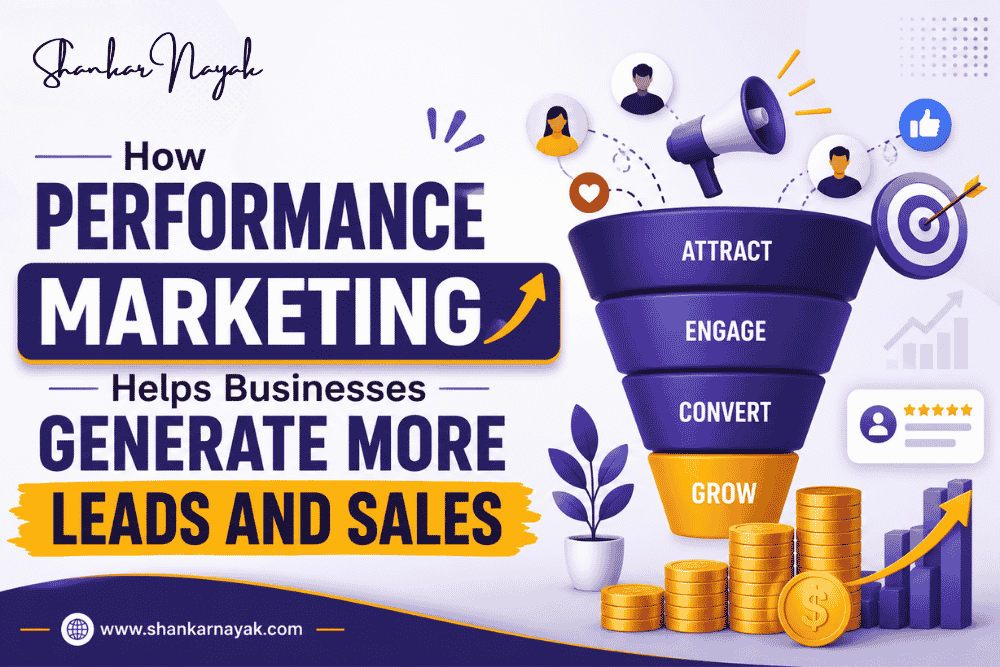
Performance marketing is one of the smartest and most result-focused digital marketing strategies available to businesses today. Unlike traditional advertising where you pay upfront and hope for results, performance marketing means you only pay when a specific result happens a click, a lead, a sign-up, or a sale. In 2026, this model has become the go-to strategy for businesses that want measurable growth without unnecessary spending.
In this article, we will break down exactly how performance marketing helps businesses generate more leads and sales, which channels work best, and how you can start thinking about it for your own business.
Performance marketing is a results-driven digital marketing model where advertisers pay only when a defined action is completed. That action could be a user clicking on an ad, filling out a contact form, downloading a resource, making a purchase, or signing up for a service.
This is fundamentally different from traditional marketing, where a business might pay lakhs of rupees for a billboard or a television ad with no guarantee of any results. With performance marketing, every rupee you spend is tied directly to a measurable outcome.
As one industry guide puts it clearly: performance marketing is not about views, likes, or reach, it is about results you can track and improve. This makes it particularly powerful for small and growing businesses that need to be careful about where every marketing rupee goes.
The biggest advantage of performance marketing is that your budget is never wasted on people who are not interested. You set a goal say, generate leads for your web development service and you pay only when someone takes that specific action.
This pay-for-performance model eliminates one of the most frustrating problems in marketing: spending money without knowing if it is working. Businesses that adopt performance marketing reduce their customer acquisition costs dramatically because every click and every lead is intentional.
Performance marketing works across several powerful digital channels, each suited to different types of audiences and business goals.
Google Ads captures people who are actively searching for what you offer. If someone searches “digital marketing agency in Bhubaneswar” or “web development for small business,” a well-placed Google Ad puts your business directly in front of them. Google Ads delivers an average return of $8 for every $1 spent, making it one of the strongest paid channels for immediate lead generation.
Meta Ads (Facebook and Instagram) work differently. Instead of capturing existing intent, they create it. You target people based on their demographics, interests, and online behaviour and introduce your business to potential customers who did not know they needed you yet. LinkedIn Ads, on the other hand, are particularly powerful for B2B businesses, with a visitor-to-lead conversion rate of 2.74% significantly higher than Facebook at 0.77% or Twitter at 0.69%.
Affiliate Marketing allows you to partner with content creators, bloggers, or complementary businesses who promote your services in exchange for a commission tied to actual results not just exposure. This makes it a zero-risk lead generation channel.
The smartest performance marketing strategies in 2026 use a combination of these channels: Google Ads to capture high-intent searches, Meta Ads to build awareness and nurture interest, and retargeting to bring back visitors who did not convert the first time.
One of the most powerful aspects of performance marketing is that everything is measurable in real time. You can see exactly how many people saw your ad, how many clicked, how many filled out your form, and what it cost to acquire each lead.
This data lets you make decisions based on evidence, not guesswork. If one ad is generating leads at ₹200 per lead and another is generating leads at ₹800 per lead, you know exactly where to shift your budget. This continuous optimisation is what separates performance marketing from every other form of advertising.
According to HubSpot’s State of Marketing Report 2026, the top five metrics that matter most to marketers today are lead quality, lead-to-customer conversion rate, ROI, customer acquisition cost, and lead volume all of which performance marketing tracks directly and automatically.
One of the most important advantages of performance marketing is that it scales. Once you find an ad, a message, or a channel that works that consistently generates leads at a cost that makes sense for your business you can simply increase your budget and get proportionally more results.
Traditional marketing does not scale this way. A print ad or a sponsorship deal has a fixed reach and a fixed cost. Performance marketing grows as your business grows, making it one of the few marketing strategies that works equally well for a small business starting out and a large company looking to expand aggressively.
A less talked about benefit of performance marketing is what it does for the relationship between marketing and sales. When marketing campaigns are designed around specific, measurable outcomes qualified leads that meet defined criteria sales teams spend less time chasing cold or unqualified contacts and more time closing deals.
Research confirms this clearly: when sales and marketing teams are aligned around shared goals and data, they generate 208% more revenue and achieve 67% higher close rates. Performance marketing creates the shared language lead quality, cost per acquisition, conversion rate that makes this alignment possible.
Traditional marketing asks you to trust the process and hope results come. Performance marketing shows you the results before you scale your investment. This single difference is why 80% of B2B sales interactions now happen through digital channels, and why businesses of every size are shifting their budgets toward performance-based strategies.
For a small business in India with a limited marketing budget, this distinction is not just useful it is essential. You cannot afford to run campaigns that may or may not work. Performance marketing gives you the confidence that every rupee you invest is working toward a measurable result.
The data from 2026 makes a compelling case for performance marketing:
These numbers are not outliers. They represent what businesses across industries are achieving right now by committing to a results-driven approach.
If you are new to performance marketing, you do not need a massive budget to begin. Start with these steps:
Step 1: Define your goal clearly: Do you want phone calls, form submissions, product purchases, or appointment bookings? The clearer your goal, the more precisely your campaign can be built around it.
Step 2: Choose your channel based on where your audience is: Selling B2B services? Start with LinkedIn or Google Ads. Selling consumer products? Meta Ads may deliver faster results.
Step 3: Build a landing page that matches your ad: The biggest reason performance marketing campaigns fail is that the ad promises one thing and the landing page delivers another. Keep them aligned.
Step 4: Track everything from day one: Set up Google Analytics, Meta Pixel, or the relevant tracking tool before you launch. Without data, you cannot optimise.
Step 5: Optimise continuously: Review your results weekly. Pause what is not working. Scale what is.
Performance marketing is not a trend. It is the natural evolution of how businesses invest in growth in a world where every decision can be measured. If you are still spending on marketing that cannot tell you exactly what results it produced, it is time to rethink your approach.
Whether you run a service business, a retail store, or a digital startup, performance marketing gives you the tools to generate more leads, convert more sales, and grow with confidence not guesswork.
If you want to explore how performance marketing can work for your specific business, feel free to connect with me at shankarnayak.com. I help businesses across India build digital marketing strategies that deliver real, measurable results.