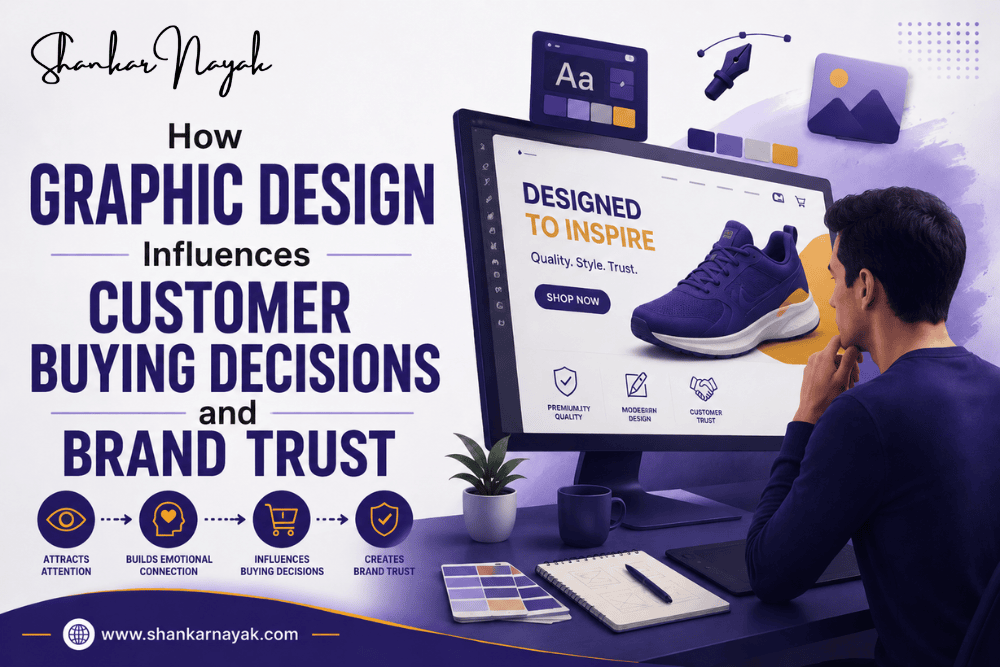

Before a customer reads a single word about your business, they have already made a judgement about it. That judgement happens within milliseconds, and it is based almost entirely on what they see, your logo, your colours, your website layout, your packaging, your social media graphics.
This is the quiet power of graphic design. It is not just decoration. It is one of the most influential, and most underestimated, factors behind whether a customer trusts your brand and chooses to buy from you.
In this article, we will explore exactly how graphic design influences buying decisions and brand trust, backed by real consumer research, and explain why investing in good design is one of the smartest decisions any growing business can make.
Human beings are visual creatures. Long before a customer reads your tagline or your product description, their brain has already processed your visuals and formed an opinion. Research shows that the visual dimension is the single biggest influencing factor in purchasing decisions for 92.6% of people.
This means that no matter how good your product or service is, if your visual presentation looks unprofessional, outdated, or inconsistent, you have already lost a portion of your potential customers before they even engage with what you are offering.
Think about it from your own experience. When you land on a website with a cluttered layout, mismatched colours, and a low quality logo, do you trust that business? Most people do not and they leave within seconds. Graphic design is the silent first conversation your brand has with every potential customer.
Trust is the single most important factor in any buying decision today. According to a comprehensive 2026 study by PwC Consumer Intelligence covering 22,000 respondents across 32 countries, trust now directly influences 92% of buying decisions globally. Brands that rank in the top quartile for consumer trust generate a 31% revenue premium over their lower-trust competitors and experience 44% lower customer churn.
Graphic design plays a direct role in building this trust. A website that is difficult to navigate, inconsistent branding across platforms, or a logo that looks dated can signal unreliability even when the actual product or service is excellent. Professional, well thought out design becomes a visual proxy for the quality and reliability of your business.
This is why 81% of consumers say that trusting a brand is a deciding factor in their purchasing decision, and almost 90% of consumers are willing to pay more for brands they trust. Design is one of the fastest ways to either build or break that trust.
Color is one of the most powerful tools in graphic design because it triggers emotional responses before any conscious thinking happens. Studies show that colour is the trigger behind 62 to 90% of consumer decisions made about a product within the first 90 seconds of interaction.
Different colours communicate different emotions. Blue is associated with trust, stability, and security, which is why it is the most common colour choice for banks, healthcare providers, and technology companies 34% of consumers directly associate blue with trust. Red creates urgency and excitement, commonly used in sales and fast-food branding. Green communicates calmness and sustainability, ideal for wellness and eco-conscious brands.
When a brand uses colour strategically and consistently, it does not just look good it actively shapes how a customer feels about the brand before they have read a single word.
Your logo is often the very first visual element a customer encounters. Research into brand identity shows that balanced, symmetrical logos create a positive perception of stability and professionalism in the minds of consumers. A consistent, well-designed signature colour and logo can increase brand recognition by up to 80%.
This recognition matters because familiarity builds comfort, and comfort builds trust. The more consistently and professionally your logo appears across your website, social media, packaging, and marketing materials, the faster customers begin to trust your brand on sight.
Fonts speak even when there is no message attached to them. Bold, structured typography signals authority and confidence. Clean, minimal fonts suggest sophistication and premium quality. Playful, creative fonts add personality and approachability.
If your typography is inconsistent or mismatched across your website and marketing materials, it creates a subtle sense of confusion that can quietly undermine customer confidence, even if they cannot consciously explain why.
A well-organised, visually balanced layout, whether on a website, a product package, or a social media ad communicates that a business is competent and detail-oriented. A cluttered or confusing layout, by contrast, creates friction. Customers subconsciously associate visual clarity with product or service quality, even before evaluating the actual offering.
One of the most overlooked aspects of graphic design is consistency. A brand that uses different colours, fonts, and visual styles across its website, Instagram page, and printed materials confuses customers and weakens brand recognition.
Consistent branding across every customer touchpoint allows people to recognise your business instantly, which builds the kind of familiarity that leads to repeat purchases and long-term loyalty. Businesses that maintain strong visual consistency see significantly stronger brand recall and customer retention over time.
Large corporations have spent decades building visual trust through consistent, professional design. Small and growing businesses do not have that luxury of time but they can achieve the same level of trust much faster by investing in strong, professional graphic design from the very beginning.
A small business with a polished, consistent visual identity can appear just as credible and trustworthy as a much larger competitor. On the other hand, a small business with weak or inconsistent design, regardless of how good its product is, will struggle to convert visitors into customers, because the very first impression works against it.
In a market where customers form opinions within seconds and trust drives the vast majority of buying decisions, design is not a cosmetic expense. It is a direct investment in customer acquisition and brand credibility.
Step 1: Audit your current visual identity. Look at your logo, website, and social media. Are they consistent in colour, font, and style?
Step 2: Choose colours intentionally. Select a colour palette based on the emotion you want your brand to communicate, and use it consistently everywhere.
Step 3: Invest in a professional logo. Your logo is the foundation of every other visual element. Make sure it is clean, balanced, and scalable across formats.
Step 4: Maintain consistency across every platform. Your website, Instagram, packaging, and printed materials should all feel like they belong to the same brand.
Step 5: Prioritise clarity over complexity. A clean, well-structured layout will always build more trust than a cluttered, busy one.
Graphic design is far more than making things look attractive. It is a strategic tool that shapes how customers perceive your brand, whether they trust you, and ultimately, whether they choose to buy from you. With trust now influencing 92% of global buying decisions, the visual identity of your business has never mattered more.
Every colour, every font, every layout decision either builds confidence in your brand or quietly erodes it. For businesses serious about growth, professional graphic design is not optional, it is one of the most valuable investments you can make in customer trust and long-term sales.
If you want to build a stronger, more trustworthy visual identity for your business, feel free to connect with me at shankarnayak.com. I help businesses across India create professional branding and graphic design that builds trust and drives real results.
Q: How does graphic design influence buying decisions?
A: Graphic design influences buying decisions by shaping first impressions within milliseconds. Visual elements like colour, logo, and layout create an instant perception of quality and trustworthiness that affects whether a customer chooses to buy.
Q: Why is graphic design important for brand trust?
A: Graphic design is important for brand trust because consistent, professional visuals signal reliability and competence. Research shows trust influences 92% of buying decisions, and design is one of the fastest ways to build or damage that trust.
Q: Does color really affect consumer behaviour?
A: Yes. Studies show colour is responsible for 62 to 90% of consumer decisions made within seconds of seeing a product, ad, or website, because colours trigger emotional responses before conscious thought.
Q: Is graphic design worth investing in for a small business?
A: Yes. Strong graphic design helps small businesses appear as credible and trustworthy as larger competitors, directly improving conversion rates and customer retention.