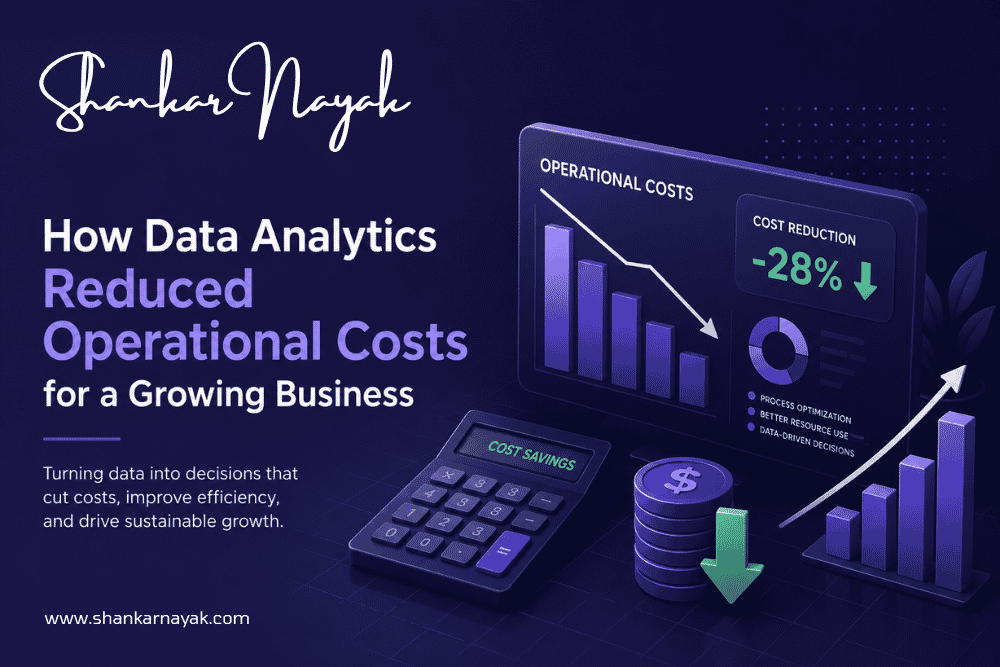

Running a growing business is exciting. But it also comes with a growing list of expenses staff costs, inventory, marketing, operations, and more. At some point, every business owner asks the same question: where exactly is the money going, and how do I stop wasting it?
The answer, for thousands of businesses around the world, has been data analytics.
Data analytics is no longer just a tool for large corporations with massive IT budgets. In 2026, businesses of every size, including small and medium enterprises are using data to cut unnecessary costs, run leaner operations, and make smarter decisions every day. In this article, we will walk through exactly how data analytics reduces operational costs for a growing business, with real-world applications you can start thinking about today.
Before diving into the cost savings, let us quickly clarify what data analytics actually means for a business.
Data analytics is the process of collecting, organising, and examining business data to find patterns, identify problems, and support better decision-making. Instead of guessing where your money is going, analytics shows you exactly what is happening across your operations from inventory movement and staff productivity to customer behaviour and supplier performance.
The global data analytics market reached $64.75 billion in 2025 and continues to grow at a 29.4% annual rate. This rapid growth tells you one thing clearly: businesses that are using data are gaining a serious competitive advantage over those that are not.
The biggest problem most growing businesses face is not that they spend too much. It is that they spend money in the wrong places without realising it.
Data analytics makes inefficiency visible. It traces the actual flow of work and money across your business and highlights exactly where resources are consumed without producing results. According to McKinsey’s 2025 State of AI Report, 80% of organisations identify operational efficiency as their primary reason for adopting analytics. When you can see which processes consume the most resources and deliver the least output, cutting costs becomes straightforward.
For example, a retail business using analytics might discover that 30% of its marketing budget is going to channels that bring in less than 5% of its revenue. Without data, that money disappears quietly. With data, the decision to reallocate it takes minutes.
One of the most expensive problems for product-based businesses is poor inventory management, ordering too much, storing excess stock, or running out of high-demand items at the wrong time. All of these scenarios cost money.
Data analytics solves this by using historical sales data, seasonal trends, and demand forecasting models to tell you exactly what to stock, when to order, and how much to keep in your warehouse. Research shows that data analytics boosts supply chain efficiency by 15% on average and improves demand forecasting accuracy by up to 50% when machine learning is applied.
For a growing business, even a 10% reduction in inventory holding costs can free up significant working capital to invest elsewhere.
For businesses that rely on equipment or machinery, whether it is a manufacturing unit, a delivery fleet, or IT infrastructure, unexpected breakdowns are expensive. Emergency repairs, halted production, and missed deadlines all carry heavy costs.
Predictive analytics changes this equation entirely. Instead of waiting for something to break, businesses use sensor data and historical maintenance records to predict when a piece of equipment is likely to fail and fix it before it does. Operational analytics alone saves manufacturing businesses an average of 20% in downtime costs. For service-based businesses, predictive IT monitoring prevents costly outages before they affect customers.
Labour is usually the largest operational cost for any business. Many business owners assume that reducing labour costs means reducing staff. Data analytics offers a smarter alternative.
By analysing workflow data, attendance patterns, and task completion rates, analytics helps businesses understand where human effort is being used most effectively and where it is being wasted on repetitive, low-value tasks that could be automated.
When businesses introduce automation for data entry, report generation, scheduling, and routine customer queries, they free their teams to focus on higher-value work. This directly reduces the cost of labour without reducing headcount. Studies show that automation powered by analytics can cut manual work in business intelligence functions by up to 45%.
Growing businesses often overspend on marketing because they spread their budget across every available channel hoping something works. This is an expensive guessing game.
Data analytics ends the guesswork. By tracking customer acquisition costs, conversion rates, and customer lifetime value across every marketing channel, businesses can clearly see which campaigns deliver results and which ones drain the budget.
Marketing ROI improves by 30% on average when businesses optimise their spending based on analytics data. For a small business spending ₹1,00,000 per month on digital marketing, a 30% improvement means the same budget either goes further or generates significantly more revenue.
Pricing is one of the most overlooked levers for cost recovery and profitability. Many businesses price their products based on gut feeling or what competitors charge. Analytics allows businesses to use real transaction data, customer sensitivity patterns, and market signals to set prices that maximise both sales and margins.
Pricing analytics increases margins by 5 to 12% across industries. For a growing business, that kind of margin improvement can be the difference between breaking even and building a healthy profit.
The numbers across industries tell a consistent story:
These are not projections. These are results that organisations across sectors are already achieving in 2026.
If you are a growing business and this is your first step into data analytics, you do not need to invest in expensive enterprise software on day one. Start simple:
Step 1: Identify your most expensive operational problems. What costs you the most and feels the most unpredictable?
Step 2: Start collecting data around that problem. Sales data, customer data, inventory records, or staff time logs whatever is relevant.
Step 3: Use accessible tools like Google Looker Studio, Power BI, or even well-structured spreadsheets to start visualising patterns.
Step 4: Let the data guide one decision. Track the result. Build from there.
The most important thing is to start. Every day you run your business on assumptions instead of data is a day you are leaving money on the table.
Data analytics is not a luxury anymore. It is one of the most practical, high-return investments a growing business can make. Whether you want to reduce wasted spend, improve your supply chain, cut downtime, or get more from your marketing budget, analytics gives you the visibility to act with confidence.
The businesses that thrive in the next five years will not be the ones that worked the hardest. They will be the ones that worked the smartest guided by real data, not guesswork.
If you want to understand how data analytics can help your business reduce costs and grow sustainably, feel free to connect with me at shankarnayak.com.